
Home » Applications » Data Centers
Every large data center is fed by its own dedicated transformer substation. Those transformers are cooled and insulated with thousands of gallons of oil, they sit in catch basins, and the yard is normally unmanned. Leakwise detects a leak from that oil while it is still a slow drip, before it becomes a fire, an outage or a reportable discharge.
Data centers are among the most power-intensive facilities being built today, and a single hyperscale campus can draw anywhere from 100 MW to more than 1,000 MW.
That power arrives through a dedicated on-site substation containing several oil-filled transformers, each holding thousands of gallons of insulating and cooling fluid. A catch basin is built under each transformer to contain small leaks, or the entire fluid volume in the event of a significant breakdown. Data center substations are normally unmanned, and continuous remote monitoring of oil leaks is essential for meeting operational, safety and environmental requirements.
Small oil leaks or spills drain into the catch basin. This oil can be carried away with the rain into the public storm drain system when the catch basins are overfilled with water. To prevent this, water is collected from the catch basins into a central sump of the substation, from where it is discharged by gravity or by a pump.
A Leakwise ID-223 Oil Sheen Detector is installed in the sump, or even directly inside the catch basin. When an oil sheen is detected on the water, or at the bottom of the sump if it is dry, an alarm is set off and the discharge pump or valve can be shut off automatically.
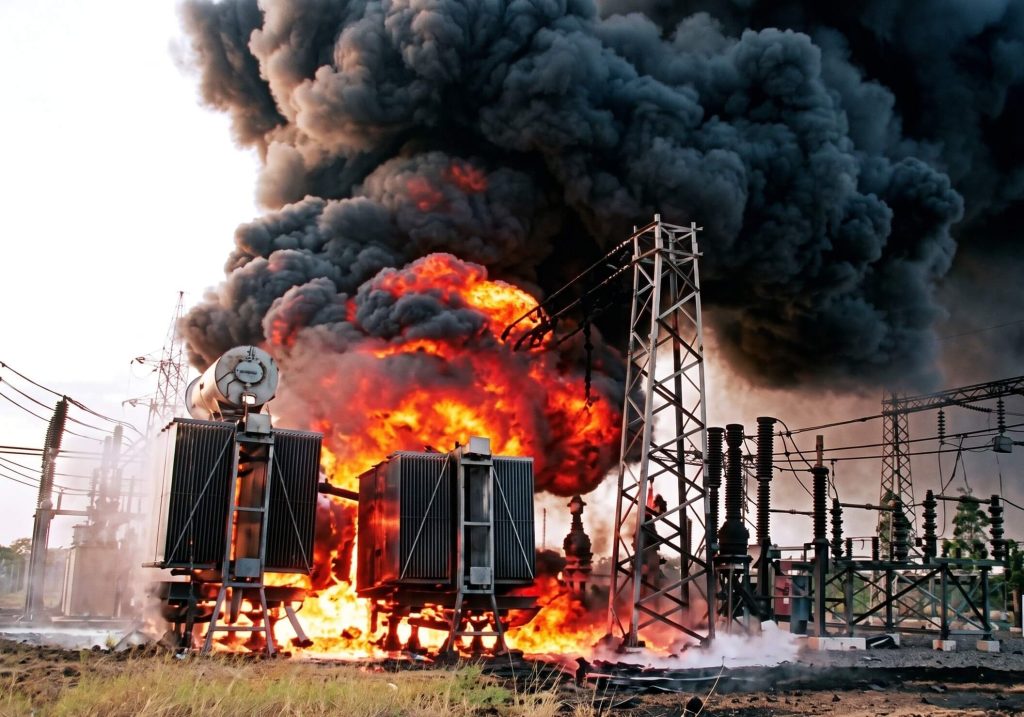
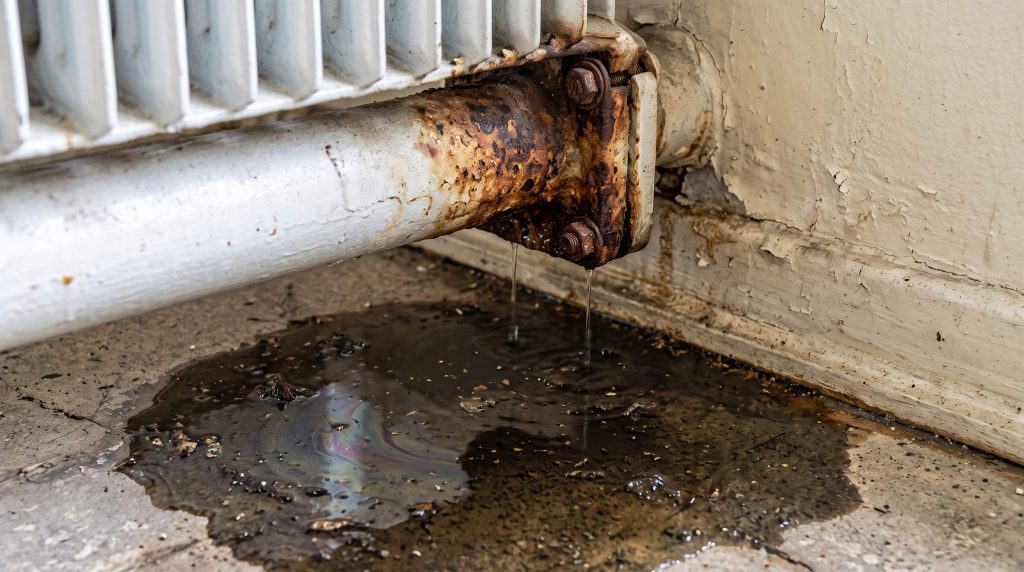
Cooling depends on the fluid circulating out to the external radiators. Most external leaks begin as seepage from a gasket, flange, valve stem or weld, at drops per hour. Winding and top-oil temperature sensors respond only once enough fluid has been lost to degrade heat transfer.
Leakwise detects the fluid that has left the tank at the earliest observable point: a layer as thin as 0.3 mm on the water surface in the containment, with alarm response meeting the 30-second requirement of FM Class 7745.
In land-constrained markets, transformers are distributed across several floors instead of a single ground-level yard. A leak on an upper floor can travel through floor drains, enter the cooling infrastructure or reach a watercourse, so a sensor is installed on every floor carrying oil-filled plant.
Leakwise sensors are selected for this duty over conventional conductive leak-detection cable, which senses the presence of liquid but cannot distinguish cooling water or condensate from transformer fluid. In a liquid-cooled building in a humid climate, that distinction is the difference between an alarm operators act on and one they eventually ignore.
At an 11-storey, US$1 billion hyperscale data center spanning 170,000 square meters in land-scarce Singapore, Schneider Electric integrated Leakwise ID-223 sensors into the facility’s critical infrastructure management. The sensors were chosen over conventional leak-detection cable for their ability to distinguish water from the StatePoint Liquid Cooling system from hazardous transformer oil.
The sensors were connected to Schneider Electric’s EcoStruxure platform, giving operators instant alerts on a unified dashboard and allowing the system to trigger shut-off valves in the drainage system automatically, so oil cannot leave the floor. The facility maintains compliance with Singapore’s National Environment Agency standards for industrial discharge, and the operations team no longer contends with the alert fatigue that a water-triggered detector would create in a tropical climate.

Three families of transformer fluid are in service: mineral oil, mostly naphthenic, which remains the most common; silicone; and bio-based or ester fluids. Leakwise sensors detect all three. Fluid selection does not drive sensor selection, and a later retrofill does not invalidate an installed system.
Standby generation adds diesel bulk storage, day tanks, transfer and unloading areas to the site. Leakwise sensors detect diesel as readily as insulating fluid, so one monitoring network covers the substation containments, the fuel bunds and the site oil/water separator.
Monitoring the separator confirms its performance and gives assurance that no hydrocarbon is carrying over to the final discharge point. Where lateral flow exceeds about 30 cm/sec, the sensor is fitted in a stilling well.
Substation containment design is guided by IEEE 980 and, in the United States, by the EPA SPCC rule (40 CFR 112), whose definition of oil covers petroleum, synthetic and vegetable-based fluids alike. Comparable requirements apply in Europe under IEC 61936-1 and in other jurisdictions. What these frameworks share is a duty to contain, to inspect, and to report a discharge promptly. Continuous monitoring at the sump and at the site discharge point is the most reliable way to meet that duty between scheduled inspections.
Schneider Electric, Singapore data center · Con Edison, New York · Potomac Electric (PEPCO) · Northland Power, Ontario · Pacific Power, Australia · Electro Corp., New Zealand · FrieslandCampina, Netherlands · University of California · Dofasco, Canada.